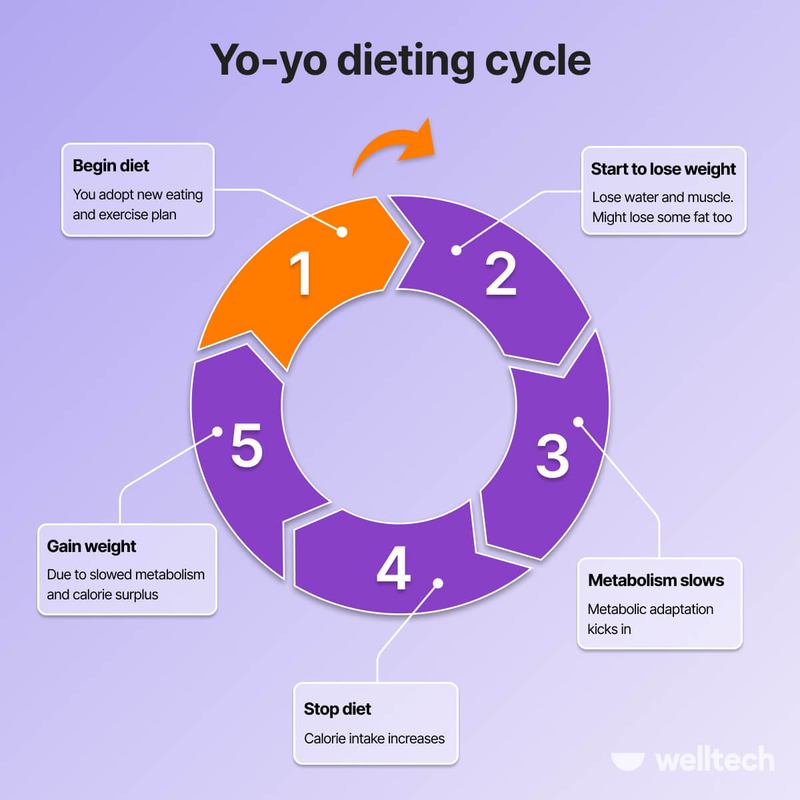
This isn't a willpower problem. It's a physiology problem. And we need to stop blaming patients for biology.
When you lose weight, your body fights back. This isn't hypothetical — it's been measured in controlled metabolic ward studies:
The famous "Biggest Loser" study showed this dramatically. Contestants lost massive amounts of weight. Six years later, their metabolisms had slowed by 500+ calories per day. Almost all had regained the weight. Their bodies were literally burning fewer calories than predicted for their new weight.
I used to tell patients: "Lose weight and keep it off." Now I say: "Lose weight, expect your body to fight back, and have a plan for that fight."
The plan includes:
I built the BMI trend tracker on this site because I got tired of patients obsessing over weekly fluctuations. Weight loss isn't linear. It's a jagged line with ups and downs. What matters is the 3-month trend, not the Tuesday morning number.
Use the trend tool. Log weekly. Look at the 12-week moving average. That's your real progress. Daily weigh-ins are data noise.
And if you regain? Don't panic. Metabolic adaptation means your body is working against you. It's not failure. It's biology. Adjust, persist, and be patient.
— James Whitfield
Most people think weight regain is about willpower. It's not. It's about neurobiology. Your brain has a "set point" — a weight range it defends through hormonal and neural mechanisms. When you lose weight below this set point, your brain perceives it as starvation and launches a multi-system counterattack.
Leptin, the hormone that tells your brain you're full, drops by 50% or more after a 10% weight loss. Ghrelin, the hunger hormone, rises by 20-30%. Your brain's reward circuits become hypersensitive to food cues — that donut in the break room isn't just tempting anymore, it's neurologically irresistible. A 2015 fMRI study showed that after weight loss, the brain's response to high-calorie foods in the amygdala and striatum increased by 40% compared to pre-weight-loss baseline.
This isn't weakness. This is survival biology. For 99.9% of human history, weight loss meant famine. Your brain doesn't know about Instagram fitness influencers or keto cookbooks. It knows that you're losing mass, and mass loss = death. So it fights back with every tool it has.
Here's something most physicians don't talk about: your gut bacteria change after weight loss, and not in a helpful way. A 2023 study in Nature followed 50 obese patients through weight loss and 2 years of maintenance. They found that post-weight-loss microbiomes were less diverse, produced fewer short-chain fatty acids (which help regulate appetite), and were more efficient at extracting calories from food.
In other words, your gut literally becomes better at absorbing calories after you lose weight. It's another layer of the metabolic adaptation that makes maintenance harder than loss. And it's completely invisible on a standard metabolic panel.
After 15 years of tracking data — my own and my patients' — here's what I've learned about sustainable weight maintenance:
1. Accept the set point. Your body has a weight range it wants to defend. Fighting it is like swimming upstream. Work with it. Aim for the lower end of your set point range, not some arbitrary number from a 1940s insurance table.
2. Build muscle first. Muscle is metabolically expensive tissue. Every pound of muscle burns 6-7 calories per day at rest. A 5-pound muscle gain = 30-35 extra daily calories burned, permanently. That doesn't sound like much, but over a year it's 10,000+ calories. That's 3 pounds of fat, just from existing.
3. Track the trend, not the number. I built the BMI trend tracker because I was driving myself insane with daily fluctuations. Your weight can vary by 3-5 pounds in a single day from water, sodium, glycogen, and hormonal cycles. The 12-week moving average is the only number that matters.
4. Plan for regain. Don't pretend it won't happen. Build a protocol: if your moving average rises above your maintenance threshold for 2 consecutive weeks, you activate "maintenance mode" — slightly reduced calories, increased steps, an extra workout. Not punishment. Protocol.
I'm going to be honest with you. The hardest part of weight maintenance isn't the biology. It's the shame. Every time the scale ticks up, there's a voice that says "you failed." Every time you eat something "off plan," there's guilt. Every family gathering becomes a minefield of judgment.
I tell my patients: your worth is not a number. Your health is not a moral achievement. Your body is not a project to be optimized. It's the vessel that carries you through your life. Treat it with respect, not punishment.
The BMI rebound is real. But so is recovery. And the data shows that people who approach maintenance with curiosity instead of fear have significantly better long-term outcomes. Be curious. Be patient. And for God's sake, stop blaming yourself for biology.
I've run the numbers on weight regain so many times that I can recite the statistics in my sleep. But here's the one that keeps me up at night: 80% of people who lose significant weight regain it within 5 years. Not 50%. Not 60%. 80%. That's not a failure of willpower. That's a failure of our understanding of human physiology.
We tell people to "eat less and move more" as if that's a complete prescription. It's not. It's a starting point. And for most people, it's not enough. Because your body doesn't want to lose weight. Your body wants to maintain homeostasis. It wants to keep you alive. And from an evolutionary perspective, losing 50 pounds in 6 months looks a lot like starvation.
The metabolic adaptation data is brutal. After losing 10% of body weight, total energy expenditure drops by 300-500 calories per day. That's not just from having less mass. That's from hormonal changes, mitochondrial efficiency improvements, and behavioral adaptations. Your body literally becomes a more efficient calorie-burning machine — which sounds good until you realize that efficiency means you need fewer calories to maintain your weight.
I used to give patients a target weight and a calorie goal. Now I give them a maintenance protocol. Because the weight loss is the easy part. Anyone can lose weight for 3 months. The hard part is keeping it off for 3 years.
The protocol includes: protein at every meal (not just dinner), resistance training 2-3x per week (non-negotiable), sleep 7-8 hours (ghrelin rises with sleep deprivation), and a 7-day moving average weight tracker (daily weigh-ins are data noise). And most importantly: a plan for what to do when the scale starts creeping up. Because it will. Not because you failed. Because biology.
I also tell them to throw away their "goal weight." Seriously. Burn it. The concept of a goal weight implies that weight loss is a project with an endpoint. It's not. It's a permanent lifestyle change. And if you think of it as a project, you'll treat the "completion" as a license to return to old habits. Which is exactly what causes regain.
The patients who succeed long-term? They don't have goal weights. They have process goals. Walk 8,000 steps. Eat protein at breakfast. Sleep 8 hours. Lift twice a week. They focus on behaviors, not outcomes. And the weight takes care of itself. Slowly. Imperfectly. But sustainably.