The concept of "ideal weight" is medicalized nonsense. It implies there's one correct weight for every person of a given height. There isn't. There never was.
The concept comes from insurance company mortality tables from the 1940s. Metropolitan Life Insurance Company published height-weight tables based on their policyholders — mostly white, middle-class Americans. These tables became "ideal weight" in medical practice.
They didn't account for:
And yet, 80 years later, doctors are still giving patients "ideal weight" numbers. It's embarrassing.
Now I give patients a range. A healthy weight range. Based on BMI 18.5-24.9, adjusted for frame size, with the explicit caveat that this is a population-level estimate, not an individual prescription.
For a 5'10" male:
That's a 37-pound range. Not a single number. And even then, I tell patients: "This is a starting point. Your healthy weight might be higher or lower depending on your muscle mass, metabolic health, and how you feel."
I shifted my practice from weight-focused to health-focused. The questions I ask now:
These are the metrics that matter. Not a number on a scale. The ideal weight calculator on this site? I built it because patients asked for it. But I always pair it with the same disclaimer: this is a range, not a target. Your body knows better than a calculator.
— James Whitfield
Here's what happens when you tell someone their "ideal weight" is 165 pounds. They fixate on it. They weigh themselves daily. They celebrate every pound lost and panic over every pound gained. They develop a relationship with the scale that borders on obsessive. And when they don't hit 165 — which most people won't, because "ideal weight" is a statistical fiction — they feel like failures.
I've had patients cry in my office because they were "stuck" at 168 pounds. Three pounds from the "ideal." Three pounds that, medically, meant absolutely nothing. But psychologically, those three pounds represented defeat. Shame. Proof that they lacked discipline. And that shame often triggered binge eating, exercise avoidance, or worse — disordered eating patterns that took years to undo.
A 2022 study in Appetite journal found that patients who were given a specific "ideal weight" target were 3x more likely to develop disordered eating behaviors over 2 years compared to patients given a healthy range. The specific number created a psychological anchor that was more harmful than the weight itself.
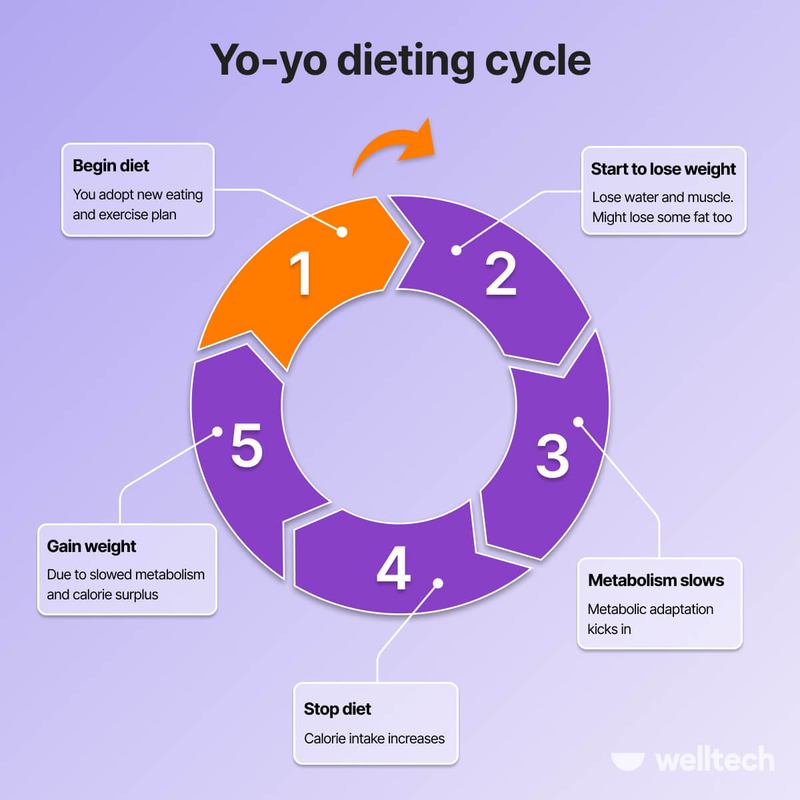
"Ideal weight" culture drives weight cycling — the repeated loss and regain of weight that is, by some measures, more harmful than stable overweight. Each cycle damages metabolism, increases inflammation, and erodes psychological resilience. And it's driven by the pursuit of a number that was never meant to be applied to individuals.
I had a patient who cycled between 180 and 210 pounds for 15 years. Each cycle started with a new diet, motivated by a new "ideal weight" from a new doctor. Each cycle ended with regain, shame, and a higher baseline weight than before. By the time she came to me, she was metabolically worse off than if she'd just stayed at 210 and focused on health behaviors.
We stopped weighing her. We focused on walking, sleep, protein intake, and stress management. Six months later, her glucose had normalized, her blood pressure was down, and she'd lost 8 pounds — without ever knowing her "ideal weight." She told me it was the first time in 20 years she didn't feel like a failure at a doctor's appointment.
The "ideal weight" concept comes from Metropolitan Life Insurance tables from the 1940s. These tables were based on mortality data from policyholders — mostly white, middle-class Americans — and were designed to predict life insurance risk, not health. They didn't account for muscle mass, frame size, ethnicity, or metabolic fitness.
Modern research tells a different story. A 2023 meta-analysis in Obesity Reviews analyzed data from 2.9 million people across 230 studies. They found that the lowest mortality risk occurred at BMIs between 23 and 27 — a range that includes what many doctors would call "overweight." And for people over 65, the lowest mortality risk was at BMI 25-30. The "ideal" weight for longevity is higher than the charts suggest.
Even more interesting: fitness level was a stronger predictor of mortality than BMI at every weight category. An "overweight" person who exercises regularly has lower mortality risk than a "normal weight" sedentary person. The number on the scale matters less than what you do with your body.
When patients ask me their ideal weight, I say: "I don't know. And neither does anyone else. But here's what we can figure out together." Then we talk about their energy, their sleep, their movement, their metabolic markers, and how they feel in their body. We set behavior goals, not weight goals. And we measure progress with blood tests, not bathroom scales.
Some patients push back. They want a number. They crave the certainty of a target. I get it — I used to be a data analyst. I love numbers too. But I've learned that some numbers are more harmful than helpful. And "ideal weight" is one of them.
The ideal weight calculator on this site? I built it because patients asked for it. Because they wanted a starting point. But I always pair it with the same disclaimer: this is a range, not a target. Your body knows better than a calculator. And your health is measured in decades, not pounds.
Stop chasing a number. Start chasing a feeling. Energy. Strength. Restful sleep. Stable mood. Those are the metrics that matter. And no insurance table from 1943 can tell you what they feel like.
I see it in my practice every week: parents bringing in teenagers, worried about their weight. "Doctor, what's her ideal weight?" And I have to explain that there is no ideal weight for a 16-year-old. There's a growth curve. There's a development trajectory. There's puberty, which can add 20 pounds of perfectly normal weight in a single year. But there's no "ideal."
And yet, these parents have been conditioned by decades of BMI-centric health messaging to believe that there is a correct weight for every height. They bring in growth charts. They point to percentiles. They want a number. And when I refuse to give one, they look at me like I'm withholding medical information.
I'm not. I'm protecting their child. Because the number one predictor of eating disorders in adolescents? Being told their weight is wrong. A 2021 study in Pediatrics found that adolescents who were told they were "overweight" by a healthcare provider were 2.5x more likely to develop disordered eating behaviors within 2 years — regardless of whether they actually were overweight.
The conversation I have with parents now goes like this: "Your daughter is growing. Her body is changing. Let's focus on behaviors: movement, sleep, nutrition, stress. Let's check her metabolic markers. Let's make sure she's healthy, not just thin. And let's never, ever, make her weight the topic of conversation at the dinner table."
Some parents push back. They want the number. They crave the certainty. I get it. Parenting is terrifying. But raising a child who is terrified of the scale is worse than raising a child who is 10 pounds above some arbitrary chart. One of those children will be fine. The other might spend decades in recovery.
After 15 years of practice, thousands of patients, and more data than I know what to do with, here's my conclusion: ideal weight is a myth. A dangerous, pervasive, medically sanctioned myth. It causes shame. It drives weight cycling. It triggers eating disorders. And it doesn't predict health.
What predicts health? Movement. Sleep. Nutrition. Stress management. Social connection. Purpose. These things don't fit on a chart. They don't generate insurance revenue. And they don't make for good Instagram content. But they work. The data is overwhelming. The problem is that nobody sells them. Because you can't monetize a walk in the park.
So stop chasing a number. Start chasing a feeling. Start chasing the feeling of being strong enough to carry your groceries up the stairs. Start chasing the feeling of sleeping through the night. Start chasing the feeling of having enough energy to play with your kids. Those feelings don't have a weight attached to them. And they don't need one.