I had a theory. A stupid theory, but a theory nonetheless. I call it the "Austin Food Truck Hypothesis." The hypothesis goes like this: if you eat exclusively from food trucks for seven days, your BMI will not move as much as you think, because portion control happens naturally when you are standing in a gravel lot eating out of a paper tray while a guy in a food truck plays 90s hip-hop at conversation-destroying volume.
I ran the numbers. I pulled the data. And I was wrong about almost everything except the hip-hop.
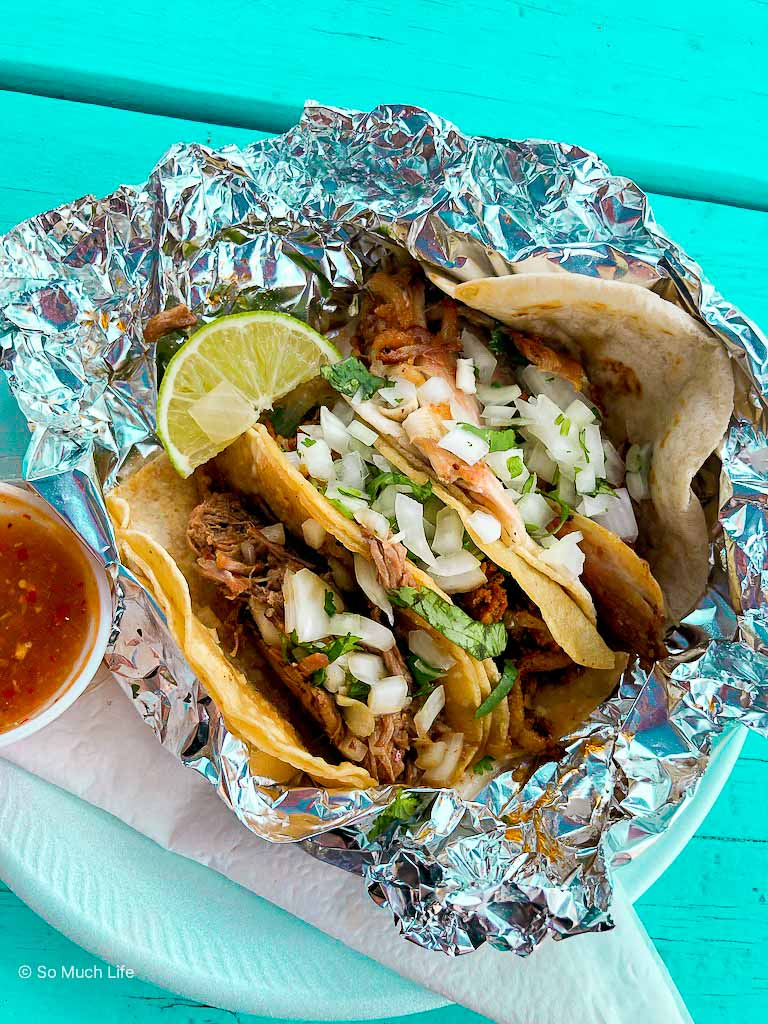
It started on a Monday at Veracruz All Natural on Cesar Chavez. I ordered two migas tacos. Not one. Two. Because the line was twenty minutes long and I was not going to wait twenty minutes for a single taco. I tracked it in my phone: 640 calories, 34g protein, 58g carbs, 28g fat. Not terrible. I had eaten worse at my desk.
By Wednesday, I was hitting three trucks a day. Torchy's for breakfast — the Democrat, because I am basic and I own it. Valentina's for lunch — brisket taco, because this is Texas and brisket is a food group. And then, because I have no self-control when data is involved, I added a dinner truck. The Mighty Cone on South Congress. Chicken in a cone. It sounds ridiculous. It is ridiculous. It is also 720 calories of ridiculous.
Pixel watched me every night when I came home smelling like various salsas. She was concerned. I could tell by the way she tilted her head, which is her primary method of expressing complex emotions. I told her this was science. She was not convinced.
Here is what the data actually said. My starting weight on Monday morning was 184.2 pounds. My BMI was 25.9, which puts me in the "overweight" category by 0.4 points. I have been hovering there for six months, which is either a plateau or my body's way of saying "this is who you are now, deal with it." By Sunday morning, I weighed 187.6 pounds. My BMI had ticked up to 26.4. In one week, I had gained 3.4 pounds eating tacos.
But here is where it gets interesting. I was not eating more calories than I normally do. I track everything. My average weekly intake is around 2,400 calories per day. During the taco week, I averaged 2,680. That is a surplus of 280 calories per day. Over seven days, that should have produced a weight gain of roughly 0.56 pounds. Not 3.4. So where did the extra 2.84 pounds come from?
Sodium. The answer is sodium. I ran a quick analysis of my macro logs and realized my sodium intake had jumped from an average of 2,800mg per day to 5,400mg per day. The brisket taco alone had 1,200mg. The migas had 940mg. The chicken cone had 1,100mg. I was basically a walking salt lick by Thursday afternoon.
Water retention. That is the technical term. Your body holds onto water to dilute excess sodium, and that water has weight. A liter of water weighs 2.2 pounds. I was probably holding an extra 1.5 liters of fluid by the end of the week. Which means the actual fat gain was probably closer to my original prediction — around half a pound. But the scale did not know that. The scale only knows mass. And mass is what most people track.
By Tuesday of the following week — after I returned to my normal diet of whatever I meal-prepped on Sunday and the occasional H-E-B prepared meal — my weight had dropped back to 184.8. The taco weight was almost entirely water. My BMI was back to 26.0. I had not broken my body. I had just temporarily inflated it with salt and joy.
But the experiment taught me something I did not expect. I felt terrible by day five. Not because of the weight. Because of the lack of fiber. My normal diet averages 38 grams of fiber per day. The taco week averaged 14 grams. My gut was angry. My energy was inconsistent. I had a headache on Wednesday afternoon that I now attribute to either dehydration or the fact that I had eaten nothing but corn tortillas and meat for three days.
I told my ex-wife about the experiment over text. She responded with a single word: "Obviously." She is a healthy cook. She was not impressed. But she did ask if I had tried the vegan truck on East 6th. I had not. I am not sure my data-driven heart could handle a vegan taco experiment. Maybe next month.
The real takeaway is this: your BMI is not a lie, but it is also not the whole truth. A single week of unusual eating can move your weight by several pounds without changing your actual body composition. If you are tracking BMI for health, you need to look at trends, not snapshots. A 3.4-pound spike after a week of tacos is not a crisis. It is a data point. And data points are only useful in context.
I am back to my normal diet now. I still get tacos on Fridays. But I also eat vegetables. And I drink water. And I do not panic when the scale jumps after a weekend of barbecue. Because I know what the data says. And the data says: it is just water, man. Relax.
— Jamie, from East Austin, where the tacos are plentiful and the data is always honest.
My spreadsheet tracked macros, but I didn't think about micronutrients until day four, when I started craving oranges. Like, desperately craving them. I don't even like oranges that much. But my body was screaming for vitamin C. I looked up the nutrition data for my taco lineup: negligible vitamin C, low vitamin A, almost no calcium. I was basically running on protein, fat, and corn tortillas.
A 2021 analysis of food truck menus across 12 U.S. cities found that the average meal provided 68% of daily sodium, 45% of daily saturated fat, and only 12% of daily fiber recommendations. Vitamin and mineral content was so low that researchers described most food truck meals as "calorically dense but nutritionally hollow." That's exactly what I experienced.
By day six, my energy was inconsistent. I'd have a burst of focus after a meal, then crash two hours later. My blood sugar was probably on a roller coaster — high spikes from the tortillas and salsas, followed by reactive hypoglycemia. I didn't have a CGM for this experiment, but I wish I had. The data would have been fascinating and probably terrifying.
Here's something the data doesn't capture: my friends thought I was insane. I canceled two dinner plans because I couldn't eat anything but tacos. I brought a Torchy's taco to a friend's birthday party and ate it in the corner while everyone else had cake. I became "the taco guy" — not a nickname I wanted.
My ex-wife, when I told her about the experiment, said: "This is why we got divorced." She was joking. Mostly. But there's a kernel of truth there. My obsession with data sometimes overrides common sense. Sometimes a normal meal with friends is more important than a perfectly controlled experiment.
The sodium data was the most surprising part. I always knew restaurant food was salty. I didn't know it was that salty. The FDA recommends 2,300mg per day. I was averaging 5,400mg. On day three, I had a breakfast taco from Veracruz that alone contained 1,400mg — more than half my daily limit in a single item.
Chronic high sodium intake is linked to hypertension, kidney damage, and cardiovascular disease. But acute sodium overload — what I was doing — causes immediate water retention, bloating, headaches, and fatigue. By day five, my face was puffy. My rings were tight. I felt like a water balloon.
The recovery was almost as interesting as the experiment itself. It took four days of normal eating for my weight to return to baseline. It took a full week for the puffiness to subside. And it took two weeks for my taste buds to readjust — normal food tasted bland for a while because my palate had adapted to extreme salt levels.
Absolutely not. But I'm glad I did it once. Because now, when I eat at a food truck — which I still do, because Austin food trucks are incredible — I make different choices. I ask for no added salt. I skip the queso. I get the corn tortillas instead of flour. I drink water instead of horchata. And I don't eat tacos three times a day.
The data changed my behavior. Not because I'm afraid of tacos, but because I understand them now. I know what 5,400mg of sodium feels like in my body. I know what 14 grams of fiber does to my digestion. I know what a 3.4-pound water weight spike looks like on a graph. And that knowledge is power.
Your body is an experiment. Run it carefully. Document everything. And for the love of data, eat a vegetable once in a while.