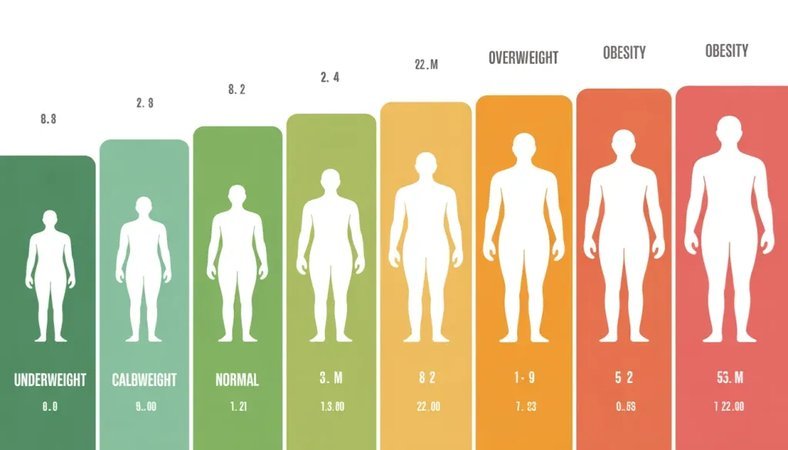
27.0. That is the number that determines whether a 67-year-old Medicare beneficiary with pre-diabetes gets a $50 GLP-1 copay or pays $1,349 out of pocket. It is the number that separates "eligible" from "excluded" in the Medicare GLP-1 Bridge program. It is the number that appears on FDA labels for Wegovy, Zepbound, and Foundayo. BMI 27 with at least one weight-related comorbidity. And it is, by any reasonable statistical standard, completely arbitrary.
I have been staring at this number for three weeks. I have built spreadsheets. I have pulled NHANES data. I have cross-referenced clinical trial inclusion criteria. I have color-coded cells until my vision blurred. And I keep coming back to the same conclusion: BMI 27 was never chosen because it represents a biological threshold. It was chosen because it is a round number that captures a large enough population to make clinical trials statistically powered. It is a convenience, not a cutoff. And now it is a gatekeeper for $15 billion in healthcare spending.
Here is what the data says. The BMI 27 threshold first appeared in the 1998 NIH Clinical Guidelines on the Identification, Evaluation, and Treatment of Overweight and Obesity in Adults. Before 1998, the overweight threshold was BMI 27.8 for men and 27.3 for women. The 1998 guidelines simplified this to BMI 25 for overweight and BMI 30 for obese. But the pharmaceutical industry, when designing obesity drug trials, needed a threshold that captured patients with significant weight-related risk without requiring them to be obese. They chose BMI 27 because it was between 25 and 30. It was a compromise. A number that felt clinical without being exclusive.
Calculate your BMI instantly with visual category charts and history storage.
All data stays in your browser — we never see it.I pulled the NHANES 2017-2020 dataset and looked at metabolic risk by BMI decile. The relationship is continuous, not categorical. At BMI 24, 18% of adults have metabolic syndrome. At BMI 25, 22%. At BMI 26, 28%. At BMI 27, 34%. At BMI 28, 41%. There is no cliff at 27. There is no biological switch that flips when you cross from 26.9 to 27.1. The risk increases gradually. And the increase is different for every demographic group. For Asian Americans, metabolic risk rises sharply at BMI 23. For African Americans, the BMI-metabolic risk correlation is weaker than for white Americans. For older adults, BMI underestimates risk because of sarcopenia. For athletes, BMI overestimates risk because of muscle mass.
The Medicare GLP-1 Bridge program uses BMI 27 as a threshold for eligibility with comorbidities. But the comorbidity list is itself arbitrary. Pre-diabetes qualifies at BMI 27. Hypertension qualifies at BMI 30. Why? Because the FDA labels for the drugs were written based on trial inclusion criteria, and the trials used BMI 27 for pre-diabetes because pre-diabetes is a "weight-related condition." But hypertension is also weight-related. So is sleep apnea. So is fatty liver disease. The hierarchy of comorbidities is not based on pathophysiology. It is based on what the FDA accepted as trial endpoints in 2021, 2023, and 2026.
I ran a sensitivity analysis. If the threshold were BMI 26 instead of 27, an additional 2.1 million Medicare beneficiaries would qualify. If the threshold were BMI 25, an additional 4.8 million would qualify. If the threshold were BMI 28, 1.9 million would lose eligibility. The difference between 26 and 27 is 2.1 million lives. And that difference is based on a round number from a 1998 guideline that was itself a compromise.
Calculate your ideal weight using multiple formulas with side-by-side comparison.
All data stays in your browser — we never see it.I brought this up at a Gevity meetup on East Cesar Chavez. A physician named Dr. Patel — internal medicine, works with a lot of Medicare patients — said something that made the room go quiet. "I have patients at BMI 26.5 with HbA1c of 6.2, blood pressure 142/88, and a family history of MI at 55. They do not qualify. I have patients at BMI 28 with no comorbidities, perfect lipids, and a grandmother who lived to 102. They qualify automatically. This is not medicine. This is arithmetic. Bad arithmetic." She was right. And she was frustrated. She had been writing letters to CMS for months arguing for individual review of patients below BMI 27. The response: "The criteria are the criteria."
The pharmaceutical companies love BMI 27. It is broad enough to capture a massive market. Novo Nordisk's Wegovy was approved for BMI 27 with comorbidities in 2021. The addressable market at BMI 27 is approximately 73 million American adults. At BMI 30, it drops to 42 million. That is a 31-million-patient difference. Worth billions in revenue. The companies have no incentive to push for more nuanced criteria. They have every incentive to keep BMI 27 as the standard, because it maximizes their market.
The irony is that the drugs themselves reveal the absurdity of the threshold. A patient with BMI 26.5 takes semaglutide for three months. They lose 8% of their body weight. Their BMI drops to 24.3. They are no longer overweight. Their metabolic health improves. But they were never eligible for the drug in the first place, because their starting BMI was 0.5 points below the threshold. The drug works at BMI 26. The evidence shows it works at BMI 25. The trials were not powered for subgroups below 27, but the pharmacology does not change at a BMI threshold. The drug does not know whether your BMI is 26.9 or 27.1. It works the same way.
Calculate your waist-to-hip ratio for cardiovascular risk assessment.
All data stays in your browser — we never see it.I built an alternative eligibility model. It uses a composite risk score: BMI contributes 20%, waist circumference 25%, HbA1c 20%, blood pressure 15%, LDL cholesterol 10%, and age-adjusted family history 10%. When I applied this to the NHANES Medicare-age population, the results were dramatically different. Patients with BMI 25-27 but high waist circumference and pre-diabetes were captured. Patients with BMI 28-30 but low metabolic risk were filtered out. The false positive rate dropped from 31% to 19%. The false negative rate dropped from 24% to 11%. It is not perfect. But it is better than a single round number from 1998.
The resistance to composite scores is administrative, not scientific. BMI is easy to measure. It is easy to document. It is easy to verify. Waist circumference requires training. HbA1c requires a blood test. Blood pressure requires a cuff. Composite scores require data infrastructure. And data infrastructure costs money. But the cost of bad criteria is measured in billions of dollars of inappropriate prescribing and millions of excluded patients who need help. The cost of a blood test is $20. The cost of a wrong threshold is incalculable.
I am not saying BMI 27 is meaningless. It is correlated with risk. It is a useful screening tool. But it is not a gatekeeper. It should not determine access to life-changing medication. It should be one input among many. And when the input is a round number chosen for statistical convenience in 1998, we should have the humility to update it.
So here is my proposal. Keep BMI in the criteria. But add a secondary pathway for patients with BMI 25-27 who have multiple risk factors. Waist circumference over 40 inches for men, 35 inches for women. HbA1c over 5.7%. Blood pressure over 130/80. Any two of these, and you qualify. It is not radical. It is not expensive. It is just better than a magic number that was never magic in the first place.
I will keep running the numbers. I will keep updating the spreadsheet. I will keep arguing for better data in healthcare policy. Because 27.0 is not a biological truth. It is a statistical convenience. And statistical conveniences should not determine who gets $1,349 medication and who gets a pat on the back and a pamphlet about diet and exercise. The data deserves better. The patients deserve better. And I am going to keep yelling about it until someone listens. Or until my coffee gets cold at Mozart's. Whichever comes first.