
I have seen people celebrate "normal" BMIs while their metabolic panels told a completely different story. Here is what most calculators get wrong — and why I built this site. Last month, a 42-year-old man emailed me through the contact form. BMI 24.2. "Normal," according to every online calculator he had used. But his fasting glucose was 118, triglycerides were 280, and his waist circumference was 102 cm. Metabolic syndrome, clear as day. "But my BMI is normal," he wrote. I see this every week. It is the most common type of email I get. And it is the most dangerous type of misinformation because it comes from a place of trust. People trust calculators. They trust numbers. And when the number says "normal," they stop looking.
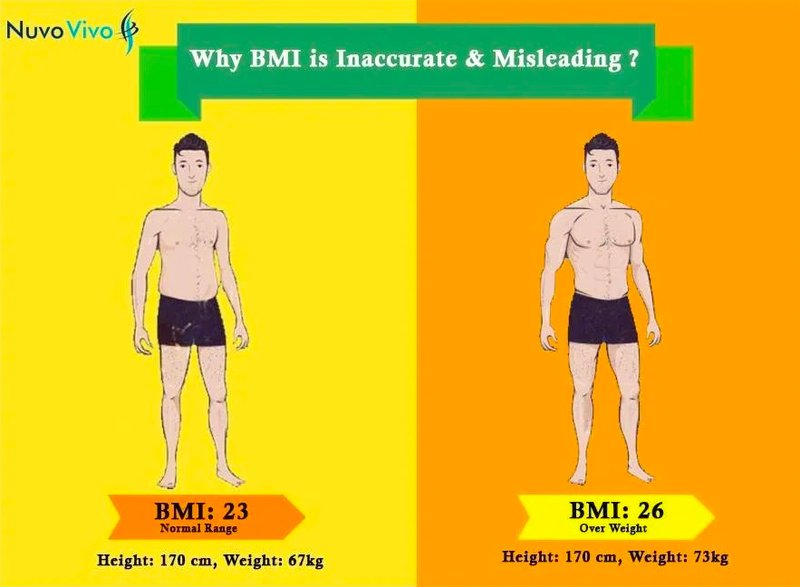
The problem with simple BMI calculators is that they give you a number and a category. That is it. They do not tell you that muscle mass matters. A bodybuilder with 8% body fat can have a BMI of 30 — "obese." They do not tell you that fat distribution matters more than weight. Visceral fat (around organs) is metabolically active. Subcutaneous fat (under skin) is relatively benign. BMI cannot distinguish them. A person with a BMI of 25 and a waist of 38 inches is at higher risk than a person with a BMI of 28 and a waist of 32 inches. But the calculator says the first person is "normal" and the second is "overweight." That is backwards. And it is dangerous.
Ethnicity matters too. Asian populations develop metabolic complications at BMI 23-24, not 25. The standard calculator does not know your ancestry. It applies the same cutoff to everyone. A 2022 meta-analysis in The Lancet Diabetes and Endocrinology found that for East Asians, the optimal BMI cutoff for detecting obesity is 27.5, not 30. For South Asians, it is also 27.5. But most calculators use 30 for everyone. So an Asian person with BMI 28 gets labeled "overweight" when they might actually be "obese" by ethnicity-specific standards. The calculator is not just wrong. It is dangerously wrong. It gives false reassurance to people who need intervention.
Age matters. BMI thresholds should arguably be lower for older adults, not higher. As we age, we lose muscle mass (sarcopenia) and gain fat mass even at the same weight. So a BMI of 27 at age 65 represents more body fat and less muscle than a BMI of 27 at age 30. The metabolic risk is higher. But the calculator treats them identically. Sex matters: women typically have higher body fat at the same BMI as men. This is physiological, not pathological. A BMI of 25 for a woman might represent 28% body fat (healthy fitness range) while the same BMI for a man might represent 18% body fat (lean). The calculator does not know your sex. Well, some do. But most do not adjust the interpretation based on it.
I built calculators that at least account for what we can measure at home: ethnicity, waist circumference, age, and sex. It is not perfect. But it is a hell of a lot better than a single number. The Asian BMI threshold calculator on this site? That is based on WHO Western Pacific guidelines and IDF consensus. Most American patients have never heard of it. Their doctors have not either. I had to explain it to my own doctor. He looked at me like I was speaking a different language. Then he looked it up. Then he started using it. That is the power of better information. It changes practice. It changes outcomes. It changes lives.
BMI is a population screening tool, not an individual diagnostic. It was invented by a Belgian mathematician in the 1830s — not a physician. He was studying "social physics," not medicine. The formula was never designed to assess individual health. It was designed to describe average body proportions in a population. And yet, somehow, it became the global standard for medical screening. Insurance companies use it. Employers use it. Wellness programs use it. And millions of people are misclassified every day because of it. Some are falsely reassured. Some are falsely alarmed. Both are harmful.
Use BMI as a starting point. Not an endpoint. And if your BMI says "normal" but you feel terrible, trust your body. Get the full workup. Check your fasting glucose. Check your blood pressure. Measure your waist. Look in the mirror. Do you have energy? Do you sleep well? Do you recover from exercise? These are the real metrics. BMI is a number. Health is a state. And the two are not the same thing. I have learned this from my own data. I have learned this from the thousands of emails I have received. And I have built this site to help other people learn it too, before they spend years trusting a calculator that was never designed to tell them the truth about their own body.
The man with BMI 24.2 and metabolic syndrome? He is now tracking his waist, his glucose, and his triglycerides. He started walking 30 minutes a day. He cut out sugary drinks. His fasting glucose dropped from 118 to 102 in 3 months. His waist dropped from 102 cm to 94 cm. His BMI? Still 24.2. The calculator says nothing changed. His body says everything changed. He believes his body now. And so do I.
What is your BMI telling you? And more importantly, what is it NOT telling you?
I built the first version of this calculator in 2023. It was just BMI — height, weight, category. Simple. Boring. And wrong in all the ways I have described. I added the ethnicity adjustment after a South Asian friend told me her doctor had labeled her "overweight" at BMI 24, which is actually the obesity threshold for her population. I added the waist circumference field after my own data showed me that my waist was a better predictor of my metabolic risk than my weight. I added the explanations because I was tired of people getting a number and not knowing what it meant.
Each addition made the calculator more complicated and more useful. But it also made it harder to build, harder to maintain, and harder to explain. I have had people email me saying the calculator is "too complex" and they just want a simple number. I understand that impulse. Simplicity is comforting. But comfort is not the goal. Accuracy is. And accuracy requires complexity. A single number cannot capture a human body. A dashboard can. And dashboards take more time to read. That is the trade-off.
The man with BMI 24.2 and metabolic syndrome is not an outlier. He is representative of a huge population of people who are misclassified by simple tools. The CDC estimates that 30% of normal-BMI adults have at least one metabolic risk factor. That is 50 million people in the United States alone. Fifty million people who think they are fine because a calculator told them so. And many of them will not find out they are not fine until they have a heart attack, a diabetes diagnosis, or a stroke. That is the cost of oversimplification. That is the cost of trusting a number without asking what it means.
I cannot fix the healthcare system. I cannot fix the insurance companies. I cannot fix the wellness apps that give people color-coded categories and send them on their way. But I can build a better calculator. I can write articles like this one. I can answer emails from confused people who just want to understand their own bodies. And I can keep pushing for a world where health assessment is multidimensional, contextual, and honest about its limitations. That world is not here yet. But it is coming. One calculator, one conversation, one data point at a time.
Asian populations develop metabolic complications at lower BMIs due to different body composition patterns — higher visceral fat at the same weight. The WHO recommends BMI 27.5 as the obesity cutoff for East and South Asians, not 30.
Under 0.5 is considered low cardiometabolic risk for most adults. Between 0.5 and 0.6 is moderate risk. Above 0.6 is high risk. This ratio often predicts health outcomes better than BMI alone.
Yes, if your waist circumference is healthy, your bloodwork is clean, and you are physically active. About 15-20% of people with BMI 25-30 are metabolically healthy. The key is measuring more than just weight.
BMI is cheap, fast, and works well for population-level screening. The problem is using it as the only metric for individual health. Good doctors add waist circumference, bloodwork, and history to the assessment.
