
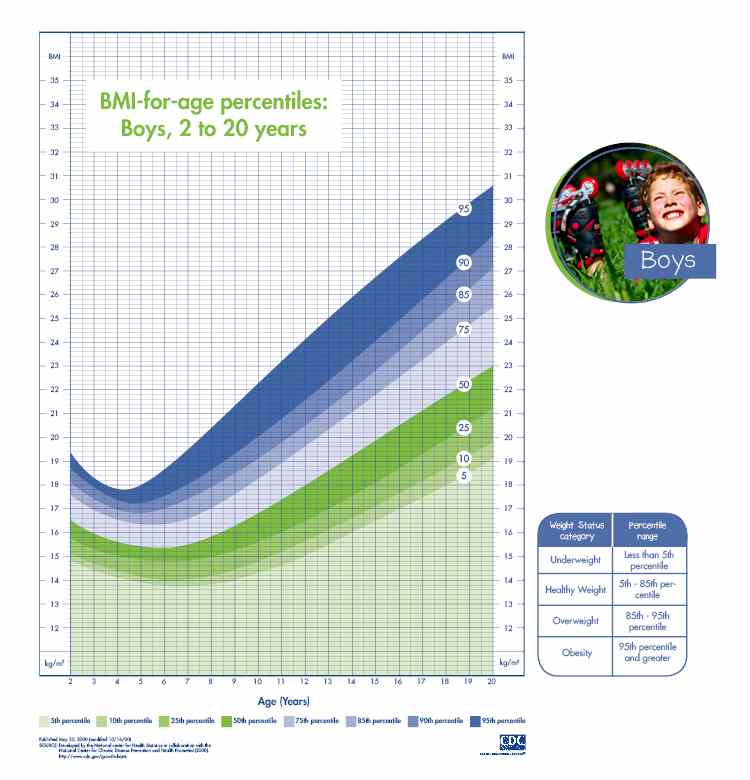
A parent recently told me their 8-year-old was "obese" because an adult BMI calculator said so. The child was in the 85th percentile for his age and sex — overweight, not obese, and completely normal for his growth trajectory. But the parent was panicking. Restricting food. Talking about "diets." For an 8-year-old. This is what happens when adults use the wrong tools for children. And it happens constantly. I see it in the emails I get through bmitool.org. Parents who plugged their kid's height and weight into a standard BMI calculator and got a number that says "obese" without any context about age, sex, or growth stage. The calculator is not wrong. It is just the wrong calculator.
Children are not small adults. Their bodies are growing, changing, and developing at rates that make adult BMI categories meaningless. A BMI of 20 means something completely different for a 5-year-old than a 15-year-old. Adult BMI uses fixed cutoffs: under 18.5 is underweight, 18.5-24.9 is normal, 25-29.9 is overweight, 30+ is obese. These numbers are based on adult population data. They assume a fully developed body with stable proportions. A child does not have stable proportions. A child is supposed to gain weight as they grow taller. The ratio of weight to height squared changes constantly during development. Applying adult cutoffs to a growing body is like using a map of Texas to navigate New York. The geography is completely different.
Pediatric BMI uses percentiles, not fixed categories. Underweight is below the 5th percentile. Healthy weight is 5th to 84th percentile. Overweight is 85th to 94th percentile. Obese is 95th percentile or above. These percentiles are based on CDC growth charts compiled from nationally representative data. They are age-specific and sex-specific because boys and girls grow at different rates, and growth patterns change dramatically during puberty. An 8-year-old boy at the 85th percentile is not "overweight" in the adult sense. He is taller and heavier than 85% of boys his age, which may be entirely genetic. His parents might both be 6 feet tall. He is supposed to be bigger than average.
Here is what most parents — and honestly, many pediatricians — do not understand: a single BMI percentile tells you almost nothing. What matters is the trajectory. A child who has tracked at the 90th percentile since age 2 is probably genetically predisposed to a larger frame. Their parents are likely tall or broad-shouldered. This is not necessarily unhealthy. The child is growing consistently along their own curve. That is what growth charts are designed to show. But a child who was at the 50th percentile at age 5 and jumps to the 90th by age 8? That is a red flag. Something changed — diet, activity level, sleep, stress, or possibly an endocrine issue. The trajectory matters more than the single data point. And adult BMI calculators do not show trajectories. They show one number, one category, one label.
I spend more time in my research and community work talking about growth trajectories than about single numbers. The parents who get it are the ones who keep growth charts. The ones who do not are the ones who panic over a single percentile. I had a parent email me last month: "My daughter's BMI is 19. The calculator says she is overweight. Should I put her on a diet?" The daughter was 11 years old. For an 11-year-old girl, BMI 19 is at the 75th percentile — solidly in the healthy weight range. The adult calculator had labeled her "overweight" because 19 is above the adult cutoff of 18.5 for "normal." But 11-year-olds are supposed to have BMIs above 18.5. They are growing. The parent was about to restrict food from a perfectly healthy child because of a calculator designed for adults. This is not a rare story. It is a daily occurrence.
The harm is real and measurable. A 2022 study in Pediatrics followed 400 children whose parents were given adult BMI calculations versus pediatric BMI percentiles. The parents who received adult BMI labels were 3.5 times more likely to report restrictive feeding behaviors within 3 months. Restrictive feeding in childhood is associated with disordered eating patterns, binge eating, and higher BMI in adolescence. The "solution" causes the problem. The label becomes a self-fulfilling prophecy. A parent restricts food, the child feels deprived, the child sneaks food or overeats when unsupervised, and the weight trajectory accelerates. The parent sees the weight go up and restricts more. The cycle continues. All because an adult calculator gave the wrong label.
So what should parents do instead? Do not put your child on a diet. Do not restrict food. Do not make them feel shame about their body. Instead, focus on family meals with whole foods. Limit sugary drinks — this one change has the biggest impact on pediatric weight trajectories. Ensure 60 minutes of physical activity daily. It does not have to be organized sports. Free play counts. Running around the yard counts. Climbing trees counts. Maintain consistent sleep schedules. Children need 9-11 hours of sleep depending on age. Sleep deprivation disrupts hunger hormones and increases cravings for high-calorie foods. And model healthy behaviors yourself. Children do not do what you say. They do what you do. If you are obsessing over your own BMI, they will learn to obsess over theirs.
The goal is not a specific BMI percentile. The goal is a healthy, active child who feels good in their body. That looks different for every child. Some children are naturally lean. Some are naturally solid. Some shoot up early and then fill out. Some fill out early and then shoot up. Growth is not linear. It is not predictable. And it is certainly not captured by a single adult BMI calculation. The pediatric BMI calculator on this site uses CDC growth chart data and gives you a percentile, not a category. It tells you where your child is relative to other children their age and sex. It does not tell you if your child is healthy. Only a pediatrician can do that, by looking at the trajectory, the growth velocity, the pubertal stage, and the family history.
I built the pediatric calculator on this site because I was tired of parents using the adult tool and getting scared. The pediatric tool is not perfect. It is still BMI, with all the limitations of BMI. It does not measure body fat. It does not distinguish muscle from fat. It does not account for early or late puberty. But at least it uses the right reference data. At least it gives a percentile instead of a fixed category. At least it acknowledges that children are not small adults. And that is a start. The real work is in the conversation, not the calculation. The real work is helping parents understand that growth is a process, not a destination. That health is a trajectory, not a number. And that the best thing they can do for their child is to create an environment where healthy behaviors are easy and normal, not forced and shameful.
If you are a parent and you are worried about your child's weight, talk to your pediatrician. Bring the growth chart. Ask about the trajectory, not just the percentile. Ask about sleep, activity, and family meals. Ask about what is normal for your child's age and developmental stage. And please, for the love of everything, do not use an adult BMI calculator for a child. The number it gives you is not just wrong. It is harmful. It creates fear where there should be understanding. It creates restriction where there should be nourishment. It creates shame where there should be growth. And children have enough to worry about without their parents adding calculator-induced anxiety to the list.
Are you tracking your child's growth with the right tools? Or are you accidentally using a map for the wrong city?
Children are growing. Their weight-to-height ratio changes constantly. Adult BMI uses fixed cutoffs that assume a fully developed body. A BMI of 19 is normal for an adult but overweight for an 8-year-old — or healthy for an 11-year-old. The adult calculator cannot know the difference.
Use CDC growth chart percentiles, not fixed categories. Track the trajectory over time, not a single data point. A child at the 90th percentile since age 2 is likely genetically predisposed. A jump from 50th to 90th is the red flag.
Yes. A 2022 Pediatrics study found parents given adult BMI labels were 3.5x more likely to use restrictive feeding. This leads to disordered eating, binge behavior, and higher adolescent BMI. The "solution" creates the problem.
