
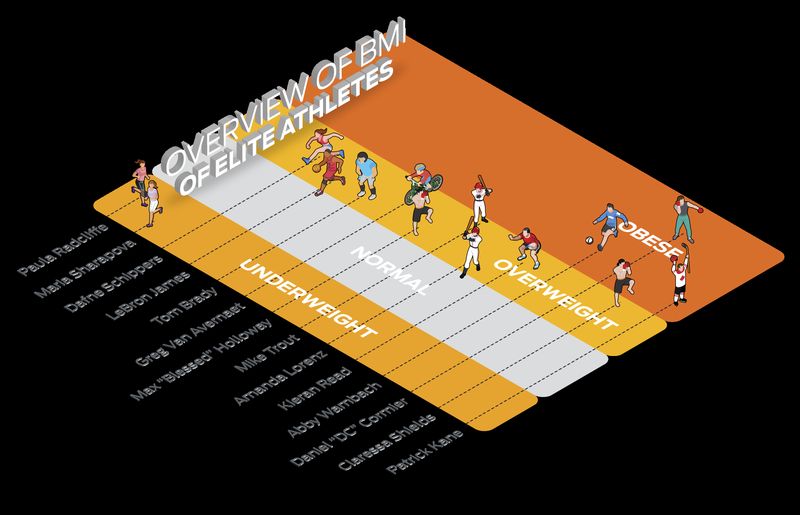
A college football player came to my gym last year. BMI 32.1. His coach had sent him to our facility because the university's health screening flagged him as "obese" and required a medical clearance before he could participate in spring training. I looked at him. He was 6'2", 245 pounds, and built like a refrigerator with legs. I measured his body fat with calipers: 8%. His waist: 82 cm. His resting heart rate: 48 bpm. This kid was not obese. He was an athlete. And BMI had just wasted everyone's time, including his.
"Your coach thinks you're obese," I told him. He laughed. Then he got angry. "I have to miss practice for this?" I felt his frustration. I've been there. Not as a football player — I ran track in college, and my BMI was always fine because distance runners are built like praying mantises. But I know what it's like to be misclassified by a metric that doesn't understand your body, your training, or your goals.
This happens constantly. BMI was never designed for athletes. It was designed for population-level epidemiology in sedentary European adults in the 1830s. Using it for athletes is like using a ruler to measure sound. The units don't match. The assumptions don't hold. And the results are meaningless at best, harmful at worst. Yet universities, insurance companies, and wellness programs keep applying it to athletes because it is easy and cheap. Easy and cheap are not synonyms for accurate and useful.
Here's why it fails so dramatically. Muscle is denser than fat. A cubic inch of muscle weighs about 15% more than a cubic inch of fat. An athlete with significant muscle mass will have a high BMI despite low body fat. The formula — weight divided by height squared — has no way to distinguish between a 245-pound football player and a 245-pound sedentary adult. It sees the same number. It spits out the same category. And it is wrong in one case and maybe right in the other. The formula doesn't know the difference. The person reading the chart should, but often doesn't.
I've seen this pattern repeatedly in my work and in the data I collect. The NFL lineman who comes in at BMI 34 with 14% body fat. Metabolically healthy. Needs that mass for his position. The powerlifter at BMI 31 with 12% body fat. Competes at national level. Eats clean, trains six days a week. The CrossFit competitor at BMI 27 with 16% body fat. Can deadlift 400 pounds and run a 6-minute mile. The bodybuilder in off-season at BMI 30 with 10% body fat. Competition-ready at BMI 26, 6% body fat.
All of these people would be classified as "overweight" or "obese" by standard BMI. All are metabolically healthier than 90% of the general population. All have been sent for unnecessary medical clearances, denied insurance discounts, or lectured by well-meaning but misinformed healthcare providers about their "weight problem." The system is broken, and BMI is one of the tools breaking it.
So what should athletes use instead? I tell every athlete I work with to ignore BMI completely. It is not a tool for you. It is a tool for population health researchers and insurance actuaries. You need metrics that reflect your actual physiology and performance, not a two-century-old formula designed for sedentary Belgians.
Body fat percentage is the obvious replacement. DEXA or Bod Pod every 3-6 months gives you a precise picture of your composition. I recommend DEXA for athletes because it also measures bone density and regional fat distribution. A football lineman needs to know if his trunk fat is creeping up even if his total body fat is fine. Central adiposity is the real risk factor, and DEXA catches it. Cost is $100-300 per scan, which is nothing compared to the cost of a season lost to a misdiagnosis or a scholarship lost to a bureaucratic checkbox.
Waist circumference is simple, cheap, and predictive. The International Diabetes Federation criteria for athletes: under 94 cm for men, under 80 cm for women. I keep a tape measure in my gym bag and check mine monthly. It takes ten seconds. It costs nothing. And it tells me more about my metabolic risk than BMI ever could. When my waist crept from 33 to 34 inches last year, I knew something was off before my DEXA confirmed it. The tape measure is the most underrated tool in fitness, and it fits in your pocket.
Performance metrics are your real health indicators. Strength, speed, endurance, recovery time. These are the numbers that matter. If your deadlift is going up and your mile time is going down, you are getting healthier. If your recovery between sets is improving and your resting heart rate is dropping, your cardiovascular system is adapting. BMI cannot measure any of this. A stopwatch and a barbell can. And they cost a fraction of what you'd spend on a DEXA scan.
Metabolic panels should be checked annually even in young athletes. Fasting glucose, lipids, inflammatory markers. I get mine done at a direct-to-consumer lab in Austin for about $150. It includes fasting insulin, hs-CRP, lipid panel, and liver enzymes. These markers tell you what is actually happening inside your body, not what a 200-year-old formula thinks should be happening based on your height and weight. My panel last year showed slightly elevated LDL — not from diet, but from genetics. My BMI never would have caught that. My bloodwork did.
Ironically, the real metabolic risk for athletes is not obesity. It is the opposite: relative energy deficiency in sport, or RED-S. Formerly known as the female athlete triad, RED-S affects male athletes too. Under-fueling, over-training, and insufficient recovery create a metabolic hole that BMI cannot detect. I've seen more metabolic problems in lean endurance athletes — BMI 19-20, body fat 8-10% — than in power athletes with BMI 30+. The lean athletes often have low testosterone, thyroid dysfunction, and bone density issues from chronic energy deficiency. Their BMI says "perfect." Their hormones say "crisis." Their performance says "declining."
A friend of mine, a marathon runner who logs 70 miles per week, came to me last year complaining of fatigue and poor sleep. His BMI was 19.5. His body fat was 9%. He looked like the picture of health. His bloodwork told a different story: testosterone below reference range, cortisol elevated, TSH borderline high. He was under-fueling by about 800 calories per day. His BMI never flagged this. His performance did. His mood did. His sleep did. He fixed it by eating more — not less — and his times improved within a month.
The BMI calculator on this site has an ethnicity adjustment, but no athlete adjustment. Maybe I should add one. But honestly? Athletes shouldn't be using BMI calculators at all. It is the wrong tool for the wrong job. You wouldn't use a kitchen scale to weigh a car. Don't use BMI to assess an athlete's health. Use body composition, performance metrics, and bloodwork. Use the tools that understand what your body actually does.
If you are an athlete and someone tells you your BMI is too high, ask them what they think your body fat percentage is. Ask them about your performance metrics. Ask them about your bloodwork. If they can't answer those questions, they are not assessing your health. They are reading a chart. And charts don't understand muscle, sweat, or sacrifice.
Are you tracking the right numbers for your body? Or are you letting a 200-year-old formula tell you who you are?
No. BMI was designed for sedentary populations and cannot distinguish muscle from fat. Athletes should track body fat percentage, performance metrics, and metabolic panels instead. BMI will almost always misclassify muscular individuals.
Relative Energy Deficiency in Sport (RED-S) occurs when athletes under-fuel relative to their training load. It causes hormonal dysfunction, bone density loss, and performance decline. BMI often misses it because weight stays stable while metabolism crashes.
Every 3-6 months via DEXA or Bod Pod. More frequent measurements create noise and obsession. Focus on performance trends — strength, speed, recovery — between body composition checks.
