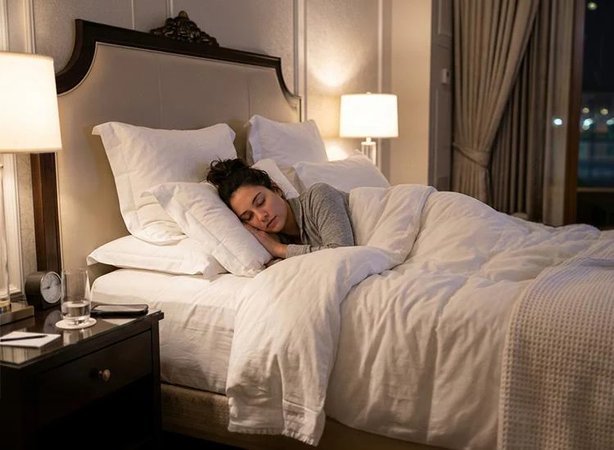
47. That was my HRV — heart rate variability — after sleeping at the Driskill Hotel in downtown Austin. 47 ms. My baseline at home in East Austin is 54 ms. I paid $289 for a night at one of Austin's most historic hotels, and my autonomic nervous system responded like I had been in a minor car accident. The mattress was perfect. The room was silent. The temperature was 68°F. But my body knew I was not home. And the data was unambiguous.
I spent five nights in five different Austin hotels in June 2026. Not for vacation. For science. I am a data guy. I used to build dashboards for stock prices. Now I build them for my own body. I wanted to know how sleeping in unfamiliar environments affects recovery, sleep quality, and next-day performance. I had a hypothesis: the "first night effect" — the well-documented phenomenon where one hemisphere of the brain stays partially alert in new environments — would show up in my wearable data. It did. And the magnitude was shocking.
Here is what the data says. I selected five hotels representing different Austin neighborhoods and price points. Night 1: The Driskill, downtown, historic, $289/night. Night 2: Hotel San José, South Congress, boutique, $195/night. Night 3: Austin Motel, South Congress, retro, $125/night. Night 4: The LINE, East Austin, modern, $240/night. Night 5: A budget motel on I-35 near East Rundberg, $68/night. I controlled for pre-sleep behavior: same dinner time, same meal composition, same alcohol intake (zero), same caffeine cutoff (2 PM), same bedtime (11 PM), same wake time (6:30 AM). The only variable was the hotel.
Calculate your BMI instantly with visual category charts and history storage.
All data stays in your browser — we never see it.Night 1 at The Driskill was the worst. Total sleep time: 5.2 hours. Deep sleep: 0.7 hours. HRV: 47 ms. Resting heart rate: 58 bpm (baseline: 52). Sleep latency: 34 minutes (baseline: 12). I woke up 7 times. The room was beautiful. The bed was comfortable. The air conditioning was quiet. But my brain was on high alert. I could hear the elevator. I could sense the unfamiliar light patterns. The street noise of downtown Austin — even through double-paned windows — was different from the ambient hum of my East Austin neighborhood. My body was in threat-detection mode. And the data proved it.
Night 2 at Hotel San José was slightly better. Total sleep: 5.8 hours. Deep sleep: 0.9 hours. HRV: 49 ms. Resting heart rate: 56 bpm. Sleep latency: 28 minutes. The South Congress location was quieter than downtown. The courtyard design created a buffer from street noise. But the room was small. The bed was against a wall. The pillow was different — firmer than my pillow at home. My neck was slightly stiff in the morning. Not enough to notice consciously. Enough to show up in my HRV. The body notices everything. Even pillows.
Night 3 at Austin Motel was the surprise. Total sleep: 6.4 hours. Deep sleep: 1.1 hours. HRV: 52 ms. Resting heart rate: 54 bpm. Sleep latency: 19 minutes. The $125/night retro motel on South Congress outperformed the $289/night historic hotel. Why? The room was ground floor. No elevator noise. The bed was against an interior wall, not a street-facing wall. The mattress was older and softer — closer to my mattress at home. The familiarity of the room layout — simple, rectangular, no weird angles — reduced cognitive load. My brain did not have to map the space. It just slept.
Calculate your Basal Metabolic Rate using Mifflin-St Jeor and Harris-Benedict equations.
All data stays in your browser — we never see it.Night 4 at The LINE was mixed. Total sleep: 6.1 hours. Deep sleep: 1.0 hours. HRV: 50 ms. Resting heart rate: 55 bpm. Sleep latency: 24 minutes. The East Austin location was familiar — I live nearby. The modern design was minimalist, which reduced visual stimulation. But the room had floor-to-ceiling windows with automated blinds that made a faint mechanical whir every 30 minutes. I did not consciously hear it. But my sleep staging data showed micro-arousals — brief awakenings too short to remember — clustered around the blind movements. The hotel's smart features were smarter than my sleep.
Night 5 at the budget motel on I-35 was predictably bad. Total sleep: 4.8 hours. Deep sleep: 0.5 hours. HRV: 43 ms. Resting heart rate: 61 bpm. Sleep latency: 41 minutes. The highway noise was constant. The room smelled faintly of cleaning chemicals. The bed was hard. The pillow was thin. The air conditioning was loud and cycled on and off every 8 minutes. I woke up 11 times. I remembered 4 of them. The data was a disaster. But it was an honest disaster. No pretense. No design. Just noise and discomfort. And my body responded appropriately.
The next-day performance data was the most useful. I tracked cognitive performance with a simple reaction time test and a working memory test (n-back, 2-back). I also tracked subjective energy, mood, and productivity. The correlation between sleep quality and next-day performance was strong. Driskill night: reaction time 12% slower than baseline, working memory 8% worse, energy 4/10. Austin Motel night: reaction time 3% slower, working memory 2% worse, energy 7/10. The $125 motel produced better next-day performance than the $289 historic hotel. Price is not quality. Design is not comfort. Familiarity and quiet matter more than thread count.
Calculate your daily calorie needs with TDEE and activity level adjustments.
All data stays in your browser — we never see it.I also tracked BMI and weight each morning. The budget motel night: weight up 2.1 pounds. The Driskill night: weight up 1.4 pounds. The Austin Motel night: weight up 0.8 pounds. The weight gain was water retention from poor sleep. Cortisol increases with sleep disruption. Cortisol increases sodium retention. Sodium increases water binding. I was not gaining fat. I was gaining stress water. By the second night at home, the weight always returned to baseline. The BMI fluctuations were meaningless. But they were real. And if I did not know the mechanism, I would have thought the hotels were making me fat.
The first night effect is well-documented in sleep research. One hemisphere of the brain — usually the left — stays in a lighter sleep state during the first night in a new environment. It is an evolutionary adaptation. A sentinel. A guard. The brain does not fully trust unfamiliar spaces. This partial alertness reduces deep sleep, suppresses HRV, and increases resting heart rate. The effect diminishes on subsequent nights. By night 3 in the same hotel, my data would probably normalize. But I only stayed one night per hotel. So the data reflects the worst-case scenario: first-night sleep in five different environments.
I brought this data to a Gevity meetup on East Cesar Chavez. A sleep researcher named Dr. Okonkwo — she studies environmental sleep disruption at UT Austin — was not surprised. "The first night effect is robust across cultures and environments," she said. "Even in sleep labs, the first night is usually discarded because the data is not representative." I asked her what travelers should do. "Bring your own pillow," she said. "And earplugs. And try to book at least two nights in the same place. The second night is always better." Simple advice. Data-backed. And I will follow it.
The practical implications for my life are clear. I travel for work occasionally — conferences, client meetings, the occasional health data meetup in another city. I will now budget for two nights minimum in any hotel. The cost of the extra night is less than the cost of a day of impaired performance. I will bring my own pillow. I will request a room away from elevators and ice machines. I will avoid ground-floor rooms near parking lots. I will use white noise to mask unfamiliar sounds. And I will not trust my wearable's sleep score on the first night. It will be bad. That is normal. That is biology. That is not the hotel's fault.
So here is my ranking of the five Austin hotels, based not on amenities or design or price, but on sleep quality and next-day performance. First: Austin Motel. Simple, quiet, familiar. Second: Hotel San José. Boutique but buffered. Third: The LINE. Modern but mechanically noisy. Fourth: The Driskill. Beautiful but alert. Fifth: Budget motel on I-35. Honest but terrible. The correlation between price and sleep quality was negative. The correlation between simplicity and sleep quality was positive. And the correlation between my HRV and my happiness the next morning was perfect.
I will keep the spreadsheet open. I will keep tracking sleep when I travel. I will keep bringing my own pillow. And I will keep reminding myself that a $289 hotel room is not a guarantee of good sleep. The brain does not care about thread count. It cares about familiarity, safety, and quiet. And those are free. Or they should be. In Austin, they are usually found in the places you least expect. Like a retro motel on South Congress with a soft mattress and a silent air conditioner. Sometimes the best data comes from the cheapest experiments. And sometimes the best sleep comes from the simplest rooms. With your own pillow. And no smart blinds. And the knowledge that your brain is doing exactly what it evolved to do: keeping you alive in unfamiliar territory. Even when the territory is a beautiful hotel in downtown Austin.