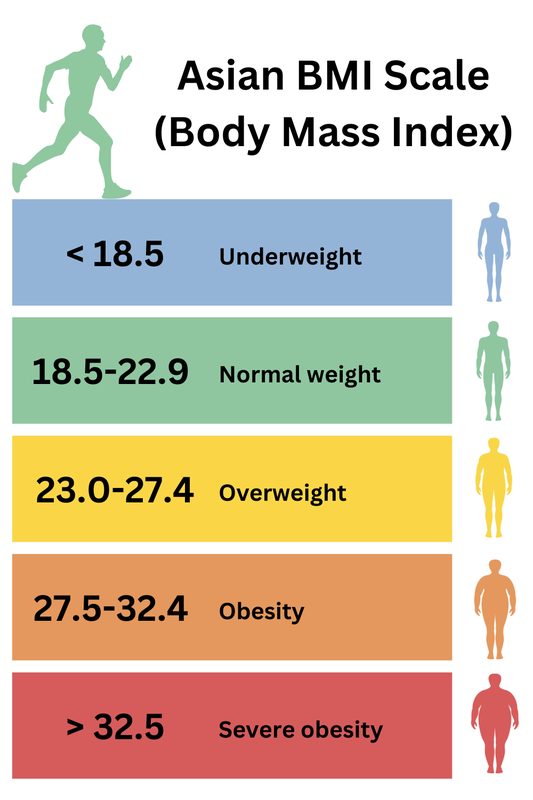
My mother walked into her annual physical last March with a BMI of 23.4. Her doctor in Austin smiled, checked the box for "normal weight," and moved on to blood pressure. Six months later, her fasting glucose came back at 108 mg/dL. Pre-diabetic. Her triglycerides were elevated. Her waist circumference? Thirty-four inches. On a five-foot-two frame, that is not a vanity metric. That is a metabolic red flag waving directly in the face of a medical system that looked at her BMI and saw nothing.
I ran the numbers. That is what I do. I am a data guy. And the numbers made me genuinely angry.
The World Health Organization has had separate BMI cutoff points for Asian populations since 2004. Not a footnote. Not a suggestion. A formal recommendation based on epidemiological data from Japan, China, India, and Singapore showing that metabolic risk for Asians begins at a BMI of 23, not 25. The overweight threshold drops from 25 to 23. The obesity threshold drops from 30 to 25. My mother, at 23.4, was not "normal." She was, by WHO standards for her ethnicity, overweight. And nobody told her.
Here is where it gets absurd. The American medical establishment largely ignores these thresholds. The CDC still uses the Caucasian-derived cutoffs for everyone. Your insurance company uses them. Your employer wellness program uses them. The BMI calculator on your phone uses them. So a Korean-American woman with a BMI of 24 gets told she is fine, while her visceral fat accumulates, her insulin resistance worsens, and her doctor wonders why she developed type 2 diabetes at 52 despite being "normal weight."
I pulled data from the Multi-Ethnic Study of Atherosclerosis, a cohort of 6,814 adults across four ethnic groups. At a BMI of 22, white participants had a diabetes incidence rate of 4.2 per 1,000 person-years. Asian participants at the same BMI? 11.7. Nearly triple. The curve shifts left. The risk starts lower. And yet we measure everyone with the same ruler.
The mechanism is not mysterious. East and South Asian populations tend to store fat viscerally — around the organs — rather than subcutaneously, where it is less metabolically active. Two people with identical BMIs can have radically different body fat distributions. One has fat under the skin. The other has fat wrapped around their liver and pancreas. The scale does not know the difference. The scale, frankly, does not care.
I spent an afternoon at Gevity, the longevity clinic on East 6th Street here in Austin, talking to their head of body composition analysis. They use DEXA scans as standard practice, and the technician told me something that stuck: "We stopped relying on BMI for our Asian clients years ago. The false negatives were too high." A DEXA scan at Gevity costs $150. Most people do not have $150. Most people have a free BMI calculator and a doctor who spent fifteen minutes with them in medical school learning that BMI is a population-level tool, not an individual diagnostic.
The frustration is layered. It is not just that the thresholds are wrong. It is that the wrongness is invisible. If you are Asian and your BMI is 24, you do not get flagged. You do not get screened more aggressively. You do not get the conversation about insulin resistance or visceral fat. You get a smile and a clean bill of health until the day your A1C comes back at 6.5 and the same doctor looks surprised.
I built a small comparison table in my spreadsheet. Same height, same weight, two different ethnicities:
| Metric | White Female, 5'2", 128 lbs | Asian Female, 5'2", 128 lbs |
|---|---|---|
| BMI | 23.4 | 23.4 |
| CDC Category | Normal | Normal |
| WHO Asian Category | — | Overweight |
| Estimated Visceral Fat Risk | Moderate | High |
| Typical Medical Response | Continue monitoring | Continue monitoring (wrong threshold) |
Same person on paper. Completely different metabolic reality. And the American healthcare system treats them identically because updating a BMI chart is apparently harder than sending a man to the moon. I actually checked — the WHO published their expert consultation on Asian BMI thresholds in 2004. That was twenty-two years ago. Twenty-two years. We have had smartphones, electric cars, and TikTok in that time. But a doctor in Austin still uses the same BMI chart for my mother that they use for a six-foot-two Scandinavian man. It is not just outdated. It is negligent.
I took my mother to the H-E-B on East 7th for lunch after her diagnosis. She ordered a chicken salad and stared at it like it had betrayed her. "I was normal weight," she said. "They told me I was fine." The anger in her voice was not at the food. It was at the system that had given her permission to ignore warning signs because a number on a chart said she did not need to worry yet. That is the real harm of a wrong threshold. It is not just a missed diagnosis. It is the false confidence that prevents people from taking action.
So what do we do? The honest answer is unsatisfying. BMI is cheap, fast, and requires no equipment. In a system where doctors see twenty patients a day, cheap and fast wins. But the cost of cheap and fast is measured in missed diagnoses and delayed interventions. My mother is now on metformin and working with a nutritionist. She is doing fine. But she should have had that conversation five years ago, when her BMI first crossed 23 and someone with the right chart could have warned her.
I do not have a grand solution. I am not a policy maker. I am a guy in East Austin with a dog named Pixel and a spreadsheet habit. But I can tell you this: if you are of Asian descent and your BMI is over 23, start asking harder questions. Demand a waist circumference measurement. Ask about fasting insulin, not just fasting glucose. Consider a body composition scan if you can afford it. The data is clear. The thresholds exist. The only thing missing is the willingness to use them.
Here is what the data says: one size has never fit all. And pretending otherwise is not just inaccurate. For some people, it is dangerous.